________________________________________
From: Michael Fenton
Sent: 27 February 2008 12:12
To: POSTBAG@THEDARRENER
Subject: Train to the Tower.
For several years now, there has been talk of Darwen evolving into a tourist destination similar to the way Hebden Bridge is presented. If the town is to prosper rather than decline or at least maintain itself, tourism would seem to be the only way forward. Certainly, the local manufacturing industry seems to be on its last legs.
The potential for tourism is there, although to make it successful, I would suggest that there ought to be more attractions than the market, the parks and Sunnyhurst Woods. The annual music festival has been a successful, positive improvement to the town, but the obvious tourist attraction is the Jubilee Tower.
It is an impressive sight from a distance, but to appreciate it fully, it is necessary to make the journey there and to enjoy the panoramic views from the top and from Winter Hill as a whole.
The problem here, of course, is that, in a year, only a smattering of the population actually make that journey, although if it was easier to get there, visitors to the Tower would increase many times.
I am suggesting, then, that this journey could be made much easier and be a great experience all round if there was a train to take people to the Tower.
Local elderly or infirm people would relish the opportunity of re-visiting the Tower, but the potential for attracting tourists to the town from outside the immediate area could be phenominal.
Darwen is easily accessible to people from Manchester, Bolton, Preston and East Lancs by train. If they could come out of the station and step onto another train either there or at the Circus, the adventure would start there for them. They would be taken through the town centre, up Borough Road, through Bold Venture Park and over the moors. It could be an amazing trip and experience.
A cosy cafe at the top would do a roaring trade and visitors could be encouraged to visit the town centre to buy local delicacies and souvenirs, have a meal, take in a concert or play at the Library Theatre etc etc.
An influx of visitors new to the area could have an enormously beneficial financial effect on the whole town and local areas. New jobs would be created and new investment attracted.
Obviously, there would be huge finacial implications initially, but surely there are grants and sponsorship opportunities available for a project like this which could revitalise a whole community. Another Jack Walker may be somewhere in the background waiting for an opportunity to make an everlasting, positive contribution to the town. Apart from the financial side, there may be environmental issues and concerns from local hikers and runners. Certainly these issues should be discussed, but they should be able to be overcome by a positive approach and some imagination and open mindedness.
To build such a railway may not be as difficult as first imagined. A railway was built over the moutains of the Isle of Man and to the top of Mount Snowdon over a much higher incline and over much worse terrain and there are other recent projects far more costly and involved such as Manchester's tram system and even the ring road around Blackburn.
Via your newspaper, it would be interesting to know what real "Darreners" think of this idea and if there is any support to instigate the idea with local government and with MP Janet Anderson.
You are invited to view my blog connected to this subject at http://traintothetower.blogspot.com
Wednesday, February 27, 2008
Email response from NWDA
---------- Forwarded message ----------
From: Katherine O'Connor (NWDA)
Date: 30 Jan 2008 14:00
Subject: Darwen Tower
To: michael fenton
Mr Fenton
Thank you for your email to the NWDA, which has been passed to me for response. Unfortunately, I have only just received this so apologise on behalf of the agency for the lengthy delay.
I read your suggestion with interest and I will forward a copy to the Lancashire and Blackpool Tourist Board. However I suggest, funding for a proposed new railway across the moors to Darwen Tower would not be feasible due to the large amount of capital required to build and the potential cost of running such an attraction. In addition to the financial issues, environmental considerations would also be difficult to overcome.
Thank you for your correspondence.
Yours sincerely
Katherine O'Connor
Tourism Partnership Manager
Northwest Regional Development Agency
PO Box 37, Renaissance House, Centre Park, Warrington, Cheshire, WA1 1XB
The Northwest Regional Development Agency (NWDA) leads the economic development and regeneration of England's Northwest.
From: Katherine O'Connor (NWDA)
Date: 30 Jan 2008 14:00
Subject: Darwen Tower
To: michael fenton
Mr Fenton
Thank you for your email to the NWDA, which has been passed to me for response. Unfortunately, I have only just received this so apologise on behalf of the agency for the lengthy delay.
I read your suggestion with interest and I will forward a copy to the Lancashire and Blackpool Tourist Board. However I suggest, funding for a proposed new railway across the moors to Darwen Tower would not be feasible due to the large amount of capital required to build and the potential cost of running such an attraction. In addition to the financial issues, environmental considerations would also be difficult to overcome.
Thank you for your correspondence.
Yours sincerely
Katherine O'Connor
Tourism Partnership Manager
Northwest Regional Development Agency
PO Box 37, Renaissance House, Centre Park, Warrington, Cheshire, WA1 1XB
The Northwest Regional Development Agency (NWDA) leads the economic development and regeneration of England's Northwest.

Monday, October 30, 2006

Wednesday, October 25, 2006

Thursday, October 19, 2006
Darwen Tower and the freeing of the moors - an article by Leslie Scott
Introduction
Around these moors are remains ofLancashire's earliest civilization, from the Bronze Age. There is evidence of stone circles, so once upon a time the moors were regarded as having magical properties. Certainly Winter Hill, Turton Heights, Great Hill and other local peaks had great astrological significance.
In more recent times Methodist and other religionists would worship on the moors, for it was on these wind swept tops that they could do so undisturbed. Coal mining was carried on for centuries on Darwen Moor as it was on the slopes of Winter Hill- probably as early as the sixteenth century. Many old pit shafts are still visible today. Quarrying was also a major industry in the district and the remains of these diggings can still be seen on and around the moor. There would be handloom weavers cottages scattered across and around the moor, and there were beer shops like "Owd Aggies" at Step Back Tockholes. Clearly walking on the moors for recreation is no recent innovation. All the moorland ways of life profited from passing walkers most of whom would be working class folks from nearby local towns. .
The Lancashire handloom weavers were great lovers of the countryside and a walk over the moors on a Sunday would be a common activity. But the moor above Darwen was also a grouse moor, the preserve of the Lord of the Manor, and there was trouble brewing by the late 19th century.
Struggle for Access
The Tower commemorates Queen Victoria's Jubilee which is the reason why it is referred to as the JubileeTower. But this local history study looks at another reason for the Tower's existence, one that is significant to Darweners, and their history. Our tale begins in 1878.
Before Darwen became a busy industrial town, there had been tenant fanners on the moors above the town, whose rights were defined in their copyholds, but with their decline it can be understood how encroachment began to be made on the owners' and public rights on the moor. Many Darwen people used the moors for leisure purposes, and also there were rights of way used by miners that led to the Eccles Sharrock coal mines at Dogshaw Clough and Entwistle Moss. When these two mines were closed and the miners disbanded many of the footpaths became disused, neglected, overgrown and forgotten. In the meantime, to forbid anyone to walk on the moor and enjoy its solitude and wildness, the owners blocked the rights of way and destroyed used footpaths. Therefore by 1877, because of this situation, very few dared to wander on the moors for fear ofthe consequences.
Yet there, v,.:as one man who did all he could to preserve the old bridle roads and footpaths across the moor. This was William Thomas Ashton. He had been a manager for Eccles Shorrock and company and had worked at their coalmines.
Part of his duties had been to sell coal to the local fanners and see that the coal was delivered from the mines and that the accounts were paid. In this way he constantly rode and walked over the bridle paths and footpaths in the area around Darwen moors Hoddlesden, Egerton, Belmont, T ockholes and Sunnyhurst. When the mines closed he defied the owners of the moors by endeavouring to keep access open. He was, at the time, Darwen's only champion to keep the moors open for walkers.
The First Efforts
William Ashton's activity was concerned mainly with the bridle paths on the moor. The footpaths had to a large extent already become overgrown and forgotten. Such was the position until 1878 when a letter appeared in the local paper, the "Darwen News". This letter called upon the people of Darwen to join the writer in a trespass on the moors. The letter was written by a local man, John Oldham. He received replies from 12 people, but on the day of the trespass only three joined him. These brave souls were Ellis Gibson, James Fish and another whose nickname was Tom O'Jorrock.
Led by John Oldham, the four climbed on to the moor, and near to Lord's Hall, John Oldham addressed the small group. They carried on their walk over a footpath that was difficult to trace but when they passed under Red Delph they found their way blocked by the gamekeepers, Edmund Bury and Richard Ainsworth. Bury was keen to get the trespassers off the moor, but Ainsworth argued that the four men were on the footpath and had right of way. For this support of the alleged trespassers, Richard Ainsworth lost his livelihood as a gamekeeper and in response joined the four in the struggle to free the moors. Richard Ainsworth knew the moors like the back of his hand and so became a valuable ally in the struggle.
In the weeks that followed the five men continued to go on to the moor tracing the footpaths.There was never any question of them doing any more than this. They were not trespassing in search of game, but asserting a public right to roam over public rights of way on the Darwen moors. The matter came to a head on the last Sunday in July 1878. On this day the five men went on to the moor to enjoy a little freedom and fresh air, above the town. The five were Richard Ainsworth, John Oldman, James Fish Ellis Gibson and a newcomer Joseph Kay. The keepers on duty that day, on the look out for trespassers, were Edmund Bury and William Shorrock, and on meeting the walkers a scuffle ensued. The keepers attempted to run the Darwen ramblers off the moor, but the ramblers refused to go.
A rush to London
On August the 1 sl 1878, a Thursday, the five men were served with writs answerable in the Chancery Division ofthe High Court of Justice in London. The writs were served on the men while they were at work, and it was of course evening before they could give them their full attention. It was a problem for them for they had never seen a writ before, never mind answered one. They therefore went for advice to one Fred Hindle, who advised them to get their evidence together as quickly as possible, for the writs had to be returned on the following day to the High Court in London. Affidavits were hastily written and sworn to, before the Town Clerk, but it was late in the night before they were completed. Their next difficulty was how were they to get to the courts in London on time? There was no train from Darwen at that hour. There was nothing else for it! John Oldman volunteered to walk to Bolton and catch the main train there. But, what about the price of the train fare from Bolton to London? He didn't have that kind of money. He had a silver watch but the pawnshop was obviously closed.Someone suggested that Jock O'Padiham might advance the money on the security of the watch. Fortunately Jack was still up, and willing to advance the money. He took the watch and handed a five pound note to John Oldman, who then set off on the six or seven mile walk to Bolton. Again luck was with him as it was a summers evening and the weather was fine.
In the City
Oldman, although tired after the long train journey, had no time for respite. He had to locate the offices of solicitors, Horne and Hunter, who then accompanied him to the Court. As they arrived at the sessions their case was just being called. Solicitor Hunter applied for extra time, and they were granted a full ten minutes. The judge was a Sir Charles Jepson who ruled that because the defendants never intended to shoot or trap game on the moor there were no charges to be laid against them. The defendants then, had won the first round, but the right to use the moors had not been resolved. If the matter was to be taken further, cash had to be raised, and more local people needed to be involved.
An Amicable Agreement
Funds began to come in; the workforce of Bowling Green Mill subscribed a penny each, while further sums came from individual towns people. A committee was formed, William Thomas Ashton becoming its Chairman. The first meeting of the committee was held in the Temperance Band Room in Foundry Street, Darwen. The room was given free of any hire charge.
Eventually it was decided that the Town Clerk should be asked if he could give support to the grand cause. He replied that when the Mayor visited London they would see the Lord of the Manor, with a view to settling the matter.
They did eventually meet with his Lordship, who claimed he was not fully aware of the problem. However he intimated that ifthey would agree that the only purpose for using the moor would be for exercise and not for sporting rights, then he would not stop Darwen people from using the moor.
An agreement was drawn up and it bound the Darwen Corporation to mapping 29 miles of road over the moor, and providing up to £100 a year for the upkeep of the paths etc. All negotiations were finally completed on September 5th 1896, and the following day a huge demonstration was held to celebrate the event. A procession of Darwen people, led by the Mayor, climbed to the place where Darwen Tower now stands. The following year, 1897, was Queen Victoria's Diamond Jubilee and on June 22nd the first sod was cut for the erection of what was to become the Jubilee Tower. It was opened in 1898 and has become a superb local landmark.
Afterwards
The town owes the freedom of the moors to those first five men who had the courage to face the Lord of the Manor's gamekeepers and challenge the trespass laws. William Thomas Ashton, John Oldman, Ellis Gibson, James Fish and Tom O'Jorrcks. A fitting tribute would be that their names could be applied to a plaque and attached to the stonework above the entrance to Darwen Tower.
Bibliography
Jubilee. The Freeing of the Darwen Moors A.H. Holden Will Yo Come on Sunday Morning? The 1896 Battle for Winter Hill Paul Salveson
Wednesday, October 18, 2006
Next stop Train to the Tower!
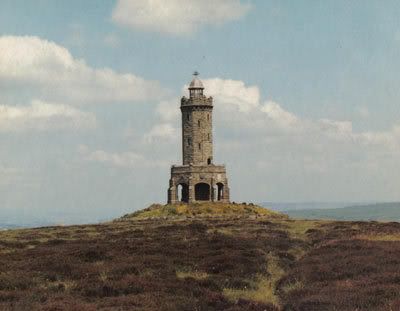
Darwen tower (obviously)

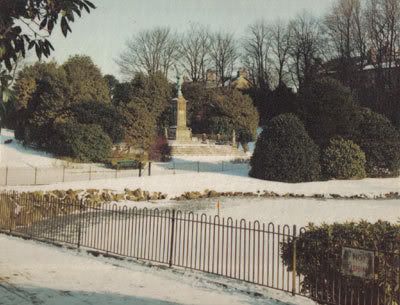
Boldventure Park

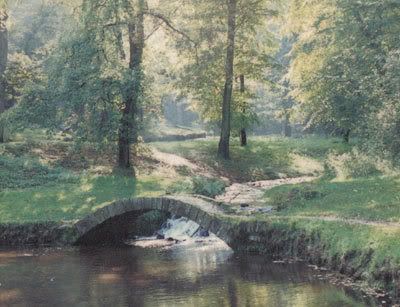
Another bit of Sunnyhurst Wood

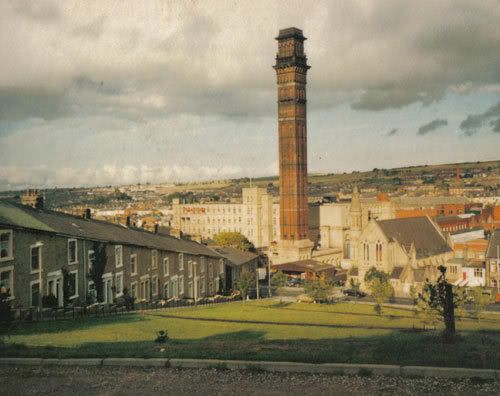
India Mill

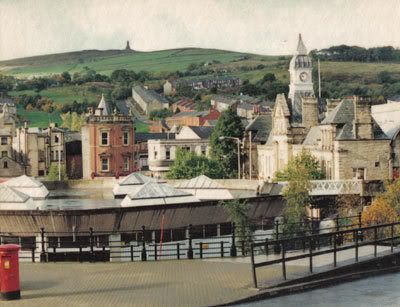
Darwen Market

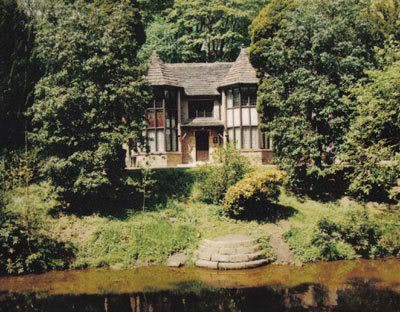
Kiosk in Sunnyhurst Wood

Boldventure Park
Another bit of Sunnyhurst Wood
India Mill
Darwen Market
Kiosk in Sunnyhurst Wood
Wednesday, September 20, 2006
Welcome to the Train to the Tower blog
Train to the tower
Darwen Tower aka the Jubilee Tower can be seen atop Darwen Moor in Lancashire. It was built to commemorate Queen Victoria's Jubilee. From the top, on a clear day, you can see the Welsh Mountains, the Isle of Man and the Lake District.A train from Darwen town centre could only be a great thing in my estimation, and I'll tell you why when I have a bit more time.Also to come: an animated version by Andy Rawsthorn.A history of the REight to Roam the Moors by local historian Lez Scott.
Darwen Tower aka the Jubilee Tower can be seen atop Darwen Moor in Lancashire. It was built to commemorate Queen Victoria's Jubilee. From the top, on a clear day, you can see the Welsh Mountains, the Isle of Man and the Lake District.A train from Darwen town centre could only be a great thing in my estimation, and I'll tell you why when I have a bit more time.Also to come: an animated version by Andy Rawsthorn.A history of the REight to Roam the Moors by local historian Lez Scott.
Subscribe to:
Posts (Atom)